Voice to Influence
Radio Host Trust: 10 Proven Ways to Build Loyal Listeners 14-06-26
How Radio Hosts Build Audience Trust
# How Radio Hosts Build Audience Trust: The Invisible Contract That Keeps Listeners Tuned In
In an age of algorithmic playlists, on-demand streaming, and AI-generated voice assistants, the idea of live radio might seem like a relic. Yet, every morning, millions of people still turn the dial (or tap the app) to hear the same familiar voice. Why? Why would someone choose a linear, scheduled broadcast over a perfectly curated Spotify playlist or an ad-free podcast?
The answer is not music, giveaways, or even breaking news. The answer is trust.
Radio hosts occupy a unique, intimate space in the lives of their listeners. They are invited into cars, kitchens, warehouses, and bedrooms. They are trusted during morning commutes, late-night shifts, and lonely afternoons. But trust on the radio is not automatic; it is not a byproduct of a good voice or a popular format. Trust is a deliberate, painstakingly built architecture of behaviors, ethics, and psychological nudges.
This blog post deconstructs the invisible contract between a radio host and their audience. We will explore the mechanics of vocal authenticity, the ethics of transparency, the power of listener representation, the art of the inside joke, and how to recover trust when it is broken. If you want to understand the deepest secrets of radio’s survival—and how any content creator can build a loyal tribe—you must understand how radio hosts build audience trust.
## Part 1: The Intimacy of the Invisible Medium
Before we discuss how trust is built, we must first acknowledge why radio is uniquely positioned to create it.
Unlike television or live streaming, radio is a low-definition medium. The listener cannot see the host’s facial expressions, their clothes, or their nervous tics. This blindness creates a phenomenon known as parasocial interaction—a one-sided psychological relationship where the listener feels they know the host intimately, even though the host does not know them.
When you listen to a radio host for six months, your brain begins to treat them as a friend. You recognize the sigh they make before reading traffic, the way they pronounce certain words, and their laugh. This familiarity lowers defensiveness. The listener stops hearing a “broadcaster” and starts hearing a “person.”
However, this intimacy cuts both ways. Because the listener feels they know the host, any breach of that perceived relationship feels personal. If a host lies, acts arrogantly, or dismisses a listener’s lived experience, the betrayal is not professional—it is emotional.
Therefore, the first rule of building trust on radio is understanding this burden. You are not just an announcer; you are a guest in someone’s daily life. Act accordingly.
## Part 2: The Pillars of Radio Trust – A Structural Framework
Over decades of studying successful radio personalities (from Howard Stern’s raw confessionals to Terry Gross’s intellectual rigor to your local morning zoo crew), researchers have identified four core pillars of trust. Every trusted host, regardless of format, masters these.
### Pillar #1: Consistency (The Reliability Pillar)
The most fundamental element of trust is predictability. If a listener knows what to expect, they will return. Consistency signals safety.
- Schedule Consistency: This is obvious but vital. If a show starts at 7:05 AM every day, listeners build their routines around it. A host who is late without explanation breaks a silent contract.
- Emotional Consistency: This is deeper. A trusted host does not wildly swing between personas. If you are the sarcastic cynic at 8 AM, you cannot suddenly become a weepy sentimentalist without narrative justification. Emotional whiplash confuses the parasocial bond.
- Content Consistency: Listeners trust that a host will deliver on the promise of their show. A sports talk host who suddenly spends 20 minutes on cryptocurrency without warning betrays the listener’s expectation. Trust is built when the listener thinks, “Ah, here’s that segment I love.”
Case Study: Paul Harvey’s “The Rest of the Story.” Harvey’s cadence, his dramatic pauses, and his signature “Page two” were so consistent that listeners felt a physical comfort in the familiarity. They trusted him because they knew exactly how he would deliver a story—and that reliability made the surprise endings even more powerful.
### Pillar #2: Vulnerability (The Human Pillar)
Perfection repels trust; vulnerability attracts it. In the early days of radio, hosts were taught to be polished, omniscient voices from on high. That model is dead. Today, listeners trust hosts who admit they don’t know everything, who share small failures, and who let the mask slip.
Vulnerability on radio takes several forms:
- Admitting mistakes: “I mispronounced that name earlier. Sorry, Maria.” This small act of correction signals that accuracy matters to you.
- Sharing struggle: “I didn’t sleep well last night. My kid is sick. If I sound tired, that’s why.” This does not mean oversharing trauma; it means acknowledging shared humanity.
- Asking for help: “I don’t understand this new TikTok trend. Can someone explain it to me?” This transforms the host from an expert to a curious peer.
The Trust Math: Vulnerability is a high-risk, high-reward strategy. If you pretend to be perfect and are later exposed, trust crashes to zero. If you admit imperfection upfront, listeners will forgive almost anything else.
### Pillar #3: Transparency (The Ethical Pillar)
Nothing destroys radio trust faster than hidden agendas. Listeners are not stupid; they know you have advertisers, station managers, and promotional obligations. The question is whether you pretend those don’t exist or whether you acknowledge them openly.
Transparent hosts do three things:
1. Label the sponsored content: “We’re about to talk about this new car, and yes, they are an advertiser. But I actually drive this model, so here’s my honest take.”
2. Explain editorial decisions: “I’m not playing that song because the lyrics are a problem for morning drive." That’s a station call, not mine.”
3. Acknowledge when they are winging it: “I have no notes for this next segment. Let’s see what happens.”
This transparency inoculates against cynicism. When a listener knows the rules of the game, they stop searching for hidden manipulation. They trust you because you have nothing to hide.
### Pillar #4: Reciprocity (The Listening Pillar)
Trust is a two-way street. But in radio, the host does most of the talking. So how do you demonstrate that you are listening? You prove it through actionable reciprocity.
- Read the texts/emails on air (and actually respond to the content, not just the name).
- Change your behavior based on feedback: “Yesterday you all told me my sound effects were too loud. I turned them down. Better?”
- Give credit: “Shout out to Lisa who corrected me on the traffic pattern. She was right.”
When listeners see their input change the broadcast, they feel ownership. And people trust what they help build.
## Part 3: The Mechanics – Voice, Language, and the Sound of Trust
The pillars above are philosophical. But trust is built in the sonic trenches. Every breath, every word choice, every pause communicates either “I am safe” or “be careful.”
### The Trustworthy Voice
Researchers in prosody (the study of vocal rhythm and pitch) have identified specific vocal traits that correlate with trustworthiness:
- Steady, moderate pace: Too fast feels manic or deceptive; too slow feels condescending. The trusted host speaks at the pace of a relaxed conversation.
- Controlled breath: Shallow, high-pitched breathing signals anxiety. Diaphragmatic breathing with a relaxed vocal fry at the end of sentences signals calm authority.
- Authentic pitch variation: A monotone voice feels robotic (untrustworthy). Wild, theatrical pitch swings feel performative (untrustworthy). Genuine, natural pitch movement that matches emotion feels real.
- The “micro-pause”: Trusted hosts pause before answering a question or before making a strong claim. That pause signals thoughtfulness. Instant answers feel rehearsed or dishonest.
### The Vocabulary of Trust
Certain words build trust; others erode it. Here is a practical guide.
Trust-Building Phrases:
- “I could be wrong, but…”
- “Here’s what I think, and here’s why.”
- “That’s a great question.”
- “I don’t know.”
- “Let me find out.”
Trust-Eroding Phrases to Avoid:
- “Believe me.” (If you have to say it, you’ve already lost it.)
- “Everyone knows that…” (Dismissive and alienating.)
- “That’s just how it is.” (Closes conversation.)
- “No offense, but…” (Always precedes an offensive statement.)
The trusted host’s vocabulary is humble, curious, and provisional. Certainty is the enemy of trust in a complex world.
### The Power of the Inside Joke
One of the most powerful trust tools is the callback—referencing something that happened three days ago or three months ago. When a host says, “This reminds me of that time we tried to call the zoo,” long-time listeners feel a rush of belonging. They are in on the joke. New listeners hear that callback and think, “I want to be part of this community.”
Callbacks signal history. History signals stability. Stability signals trust.
## Part 4: Handling Controversy – The Crucible of Trust
Any radio host can be charming when things are easy. True trust is forged in controversy. How you handle a mistake, a public feud, or a sensitive topic will define your relationship with your audience forever.
### Scenario A: You Say Something Wrong (Factual Error)
Wrong Response: Ignore it. Let the error stand. (Trust slowly leaks out.)
Better Response: Quietly correct it the next day. (Trust holds.)
Best Response: Correct it immediately, thank the listener who caught it, and explain how you will prevent it from happening again. (Trust grows.)
Why does the “best” response grow trust? Because you turned an error into a demonstration of your integrity. You showed that being right is less important to you than being honest.
### Scenario B: You Offend Someone (Tone or Content Error)
This is trickier. Offense is often subjective. The trusted host does not immediately grovel at every complaint (that signals panic). But they also do not double down (that signals arrogance).
The Trust Formula for Offense:
1. Listen first: On air, say, “Several of you have said my comment about X was hurtful. I want to understand why.”
2. Validate without necessarily agreeing: “I hear that you felt dismissed. I’m sorry my words landed that way.”
3. Explain intent but own impact: “I was trying to be funny, but I clearly missed the mark. That’s on me.”
4. Change behavior: “I won’t make that kind of joke again.”
Notice what this formula does not do: It does not demand the listener accept an apology. It does not make excuses. It simply demonstrates accountability. That is trust.
### Scenario C: You Are Attacked by Outsiders (Social Media, News, etc.)
Sometimes a host becomes a target not for what they did but for what they represent. In these moments, the audience watches to see if the host will fold, fight dirty, or stand firm with dignity.
The trusted host does three things:
1. Acknowledges the attack briefly: “Some people online are upset about my position on X.”
2. Refuses to amplify the attackers: Does not read nasty tweets on air (that rewards the trolls).
3. Reaffirms the community: “You know me. You’ve listened for years. You know my heart. Let’s keep talking.”
By turning outward attacks into an opportunity to turn inward toward the loyal audience, the host solidifies the parasocial bond. The listener thinks, “They’re attacking our host. We will defend them.”
## Part 5: The Local Advantage – Trust Through Proximity
National hosts (think Howard Stern or NPR’s Morning Edition) can build trust through talent and production value. But local radio hosts have a secret weapon: geographic and cultural proximity.
A local host who shops at the same grocery store, whose kids go to the same schools, and who complains about the same potholes is fundamentally more trustworthy to a local listener than any national voice. Why? Because the listener can verify the host’s life. There is accountability.
Local hosts build trust by:
- Speaking specifically about local landmarks: Not “the coffee shop on Main” but “the Dunkin’ next to the closed Blockbuster.”
- Attending local events (and talking about it): “I was at the high school football game Friday night. Coldest game in ten years. Your parents are heroes.”
- Suffering the same local problems: If there is a boil water advisory, the local host should be boiling water too—and should sound annoyed about it.
This shared experience is the gold standard of radio trust. The listener does not just like the local host; they feel seen by them.
## Part 6: The Long Game – Trust as a Compound Asset
Trust does not spike. It compounds.
A new radio host might have high initial curiosity but not trust. Curiosity is “I wonder what they will say next.” Trust is “I know they will handle this situation well.” Curiosity burns fast; trust endures.
Consider the compound nature of trust:
- Year 1: Listeners are skeptical. The host builds small wins—being on time, admitting mistakes, and being helpful.
- Year 2: Listeners begin to anticipate the host’s reactions. They start calling in. They defend the host to friends.
- Year 3+: Listeners will follow the host to a new station, a new time slot, or a new podcast. The trust has been capitalized.
This is why veteran hosts who have been on the air for 20 years can survive scandals that would destroy a newcomer. They have built a massive trust bank account. A single bad withdrawal (a mistake) does not bankrupt them. But even they must be careful—compound trust can also compound decay if ignored.
## Part 7: Digital Extensions – Trust Beyond the FM Dial
Modern radio hosts are not just on the radio. They are on Twitter, Instagram, TikTok, and podcast platforms. Each new platform is a trust opportunity—and a trust risk.
### How to Extend Trust to Digital
- Same person, different medium: Your radio persona and your social media persona should be recognizably the same person. Inconsistency signals performance.
- Use digital for depth, not just promotion: A radio segment is two minutes. An Instagram story can be 24 hours of behind-the-scenes reality. Show the prep, the mistakes, the unfiltered moments.
- Respond digitally (but set boundaries): Nothing builds trust like a host who replies to a DM or comment. But also, nothing destroys trust like a host who replies angrily at 2 AM. Set hours for digital engagement.
### The Podcast Paradox
Many radio hosts now have podcasts. The podcast is often more intimate, less censored, and longer-form. This can deepen trust with super-fans. However, beware: if your podcast reveals a radically different personality than your radio show, listeners will feel deceived. The radio show will start to sound like “acting.”
The best practice: Use the podcast to explore topics you cannot cover on radio (language, adult themes, deep dives), but maintain the same ethical core—honesty, vulnerability, consistency.
## Part 8: When Trust Breaks – The Apology Episode
No matter how careful you are, there will come a day when you break trust. You will say something cruel. You will be caught in a lie. You will betray a confidence. The question is not if but when.
Most radio hosts ruin the apology. They make it about themselves (“I’m so upset that I hurt you”), they make excuses (“I was under pressure”), or they make it conditional (“I’m sorry if you were offended”).
Here is the anatomy of a trust-rebuilding apology on radio:
### Phase 1: Immediate Acknowledgment (Within 24 hours)
Get on air. Do not hide. Say the thing you did wrong in plain language, without euphemism. Do not say “I made a mistake.” Say “I called that caller a liar, and that was wrong.”
### Phase 2: Take Specific Responsibility
Avoid passive voice. “Mistakes were made” is garbage. “I made a mistake” is better. “I made a cruel and unnecessary comment because I was feeling defensive” is best.
### Phase 3: Describe the Repair
What are you actually going to do to fix this? “I am going to personally call that listener and apologize. Then I am going to take two days off air to reflect. Then I am going to come back and take your calls about what I did.”
### Phase 4: No Demands for Forgiveness
Do not say “I hope you can forgive me.” That puts the burden on the listener. Say “I know I have to earn your trust back. I will start now.”
### Phase 5: The Follow-Through
The apology is not the end; it is the beginning. For weeks or months afterward, the host must demonstrate changed behavior. Any relapse resets the clock.
## Part 9: Ten Daily Habits of Highly Trusted Radio Hosts
Theory is fine, but trust is built in the mundane. Here are ten concrete, daily actions that separate trusted hosts from mere announcers.
1. Start with a check-in, not a bit: “How are you today? ” before any promo or song.
2. Name your sources: “According to the AP story I read at 6 AM…” not “They say…”
3. Correct yourself publicly, even if no one noticed the error.
4. Say “I don’t know” at least once per show.
5. Read one critical email on air and respond thoughtfully.
6. Give away the ending of your own bit if it helps a listener. “Spoiler alert – this story ends badly, so if you’re having a rough day, skip ahead.”
7. Use listener names when reading their messages.
8. Explain the production: “We’re going to a break because the engineer needs a bathroom run.”
9. Admit when you’re tired, grumpy, or distracted.
10. Sign off with a genuine wish for the listener’s well-being, not just a station ID.
## Part 10: Conclusion – Trust Is the Only Metric That Matters
In the radio industry, consultants obsess over ratings (AQH share, cume, TSL). Program directors obsess over format clocks and stop sets. Advertisers obsess over ROI.
But none of those metrics exist without trust.
A listener with high trust will:
- Tolerate more commercials.
- Stay tuned through a bad song.
- Follow the host to a new time slot.
- Defend the host in public.
- Buy from sponsors because “my host believes in them.”
A listener with low trust does none of those things. They are one click away from Spotify.
The beautiful irony is that building trust does not require a massive budget, a famous voice, or a hit music format. It requires only discipline in the small things: showing up on time, admitting when you are wrong, listening more than you perform, and treating every listener as a neighbor, not a number.
The next time you turn on your radio—or your app, or your podcast feed—listen for the trust. It is not in the sound effects or the promos. It is in the sigh before the traffic report. It is in the pause after a hard question. It is in the host who says, “I don’t know, let’s figure it out together.”
That is the invisible contract. That is how radio survives. And that is how any of us—broadcasters, creators, leaders—can earn the only thing that matters in a noisy world: the trust of another human being.
---
Now it’s your turn. Think about the radio host you trust most. What did they do today—consciously or unconsciously—to earn that trust? And what can you learn from them?
HEY, I’M Ramesh

...I was born in Ambernath the Holy Place of God Shiva. A very Famous Historical Temple Named Shiv Mandir. Many people from outside come and visit every Monday it has huge crowd. Myself with Family also used to go and sit their and experience Peace. It is near Mumbai Dist- Thane. I was very dear n lovely child in my Family because of my smiling face n cheerful nature but some people used to get angry due to My laughing habit.


JOIN MY MAILING LIST
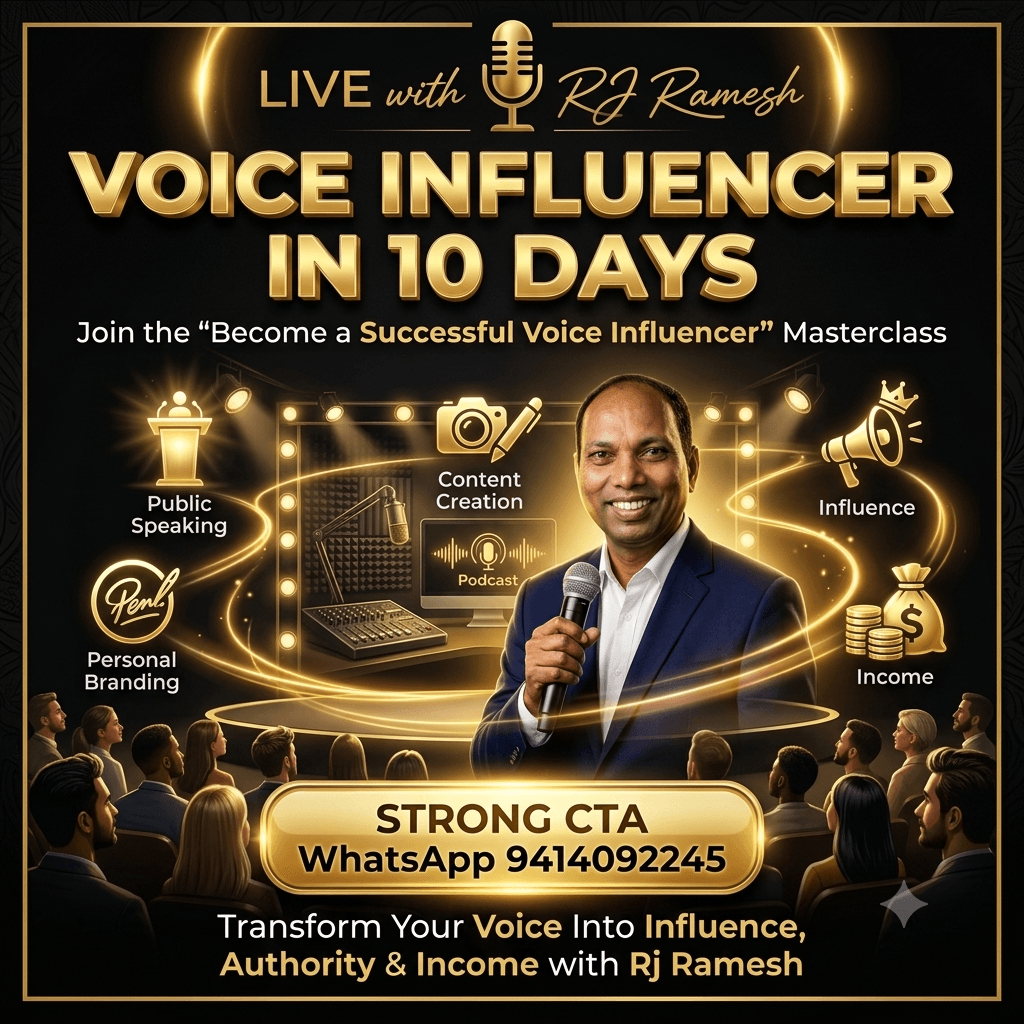
Become A Voice Influencer
Learn how powerful communication and voice coaching can build confidence, influence people, strengthen leadership, and transform your life. Join Rj Ramesh's voice influencer journey.
Why Your Voice Is More Valuable Than Ever. A few decades ago, opportunities to reach large audiences were limited.
People needed access to radio stations, television channels, newspapers, or publishing houses. Today, the internet has changed everything. Anyone with a smartphone

Digital coaching and AI are not opposing forces.
They are complementary forces. AI provides speed.
Humans provide wisdom. AI processes information.
Humans create meaning. AI generates possibilities.
Humans make decisions. The future belongs to individuals who learn how to combine both. Whether you are a coach, speaker, trainer, entrepreneur, educator, or voice influencer, the opportunity has never been greater. Use technology wisely. Continue developing your communication skills.
Build authentic relationships. Share your knowledge generously.
And remember: The most powerful technology in the world is still the human mind guided by purpose. AI can amplify your voice. But only you can provide the message.