Voice to Influence
How Introverts Can Become Powerful Speakers: Your Step-by-Step Guide 11-06-26
How Introverts Can Become
Powerful Speakers
There is a long-standing myth in the business and creative worlds: to be a great public speaker, you must be a naturally outgoing, high-energy extrovert. We see the booming voices on the TED stage or the charismatic leader dominating a boardroom, and we assume that level of influence is out of reach for those who thrive in quiet reflection.
If you are an introvert, you probably know the internal struggle. The sheer idea of speaking to a large group may cause your palms to sweat. Your energy—that precious reservoir you fill by being alone—drains rapidly in highly social environments. This leads to the dangerous conclusion that your natural temperament is a barrier to successful communication.
But the exact opposite is true.
Some of the world's most influential and impactful speakers—from Barack Obama and Eleanor Roosevelt to Susan Cain and Simon Sinek—are self-described introverts. They don't succeed despite their introversion; they succeed because of it.
Your natural quietness isn't a limitation; it’s your secret weapon. If you understand how to harness your unique strengths, you can stop dreading the stage and start dominating it.
Here is your essential guide to transforming your innate introverted superpowers into a profound speaking ability.
1. Reframe the Mission: Ditch the 'Performance'
The most critical mental shift for any introverted speaker is this: Public speaking is not a performance. It is an act of service.
As introverts, we naturally dislike being the center of attention. When we view a speech as a "show" where everyone is judging us, we are doomed to anxiety. The pressure to be entertaining, witty, or "on" is suffocating.
Instead, shift your focus entirely away from yourself and onto your audience.
You have information that your audience needs.
You are there to solve their problem.
You are giving them a gift—your insight.
When you realize your speech is not about you, but rather about the valuable idea you are conveying to them, you take the pressure off. You are no longer trying to impress; you are just a guide. This single conceptual change can instantly lower your anxiety levels by 50% and unlock your natural empathy.
2. Leverage Your Superpower: Rigorous Preparation
The world of spontaneous banter can be exhausting for an introvert. But we naturally excel at deep work, thorough research, and careful planning. This is where you will find your competitive edge.
An extrovert might feel comfortable winging a presentation, relying on charisma. You will not. You will over-prepare, and your audience will love you for it.
Your 3-Step Prep Strategy:
Deep-Dive Research: Become an expert on your subject. This deep knowledge doesn't just make your content better; it becomes the bedrock of your confidence on stage. When you are truly an expert on the topic, you aren't memorizing—you are sharing truths.
Meticulous Outlining: Structure your speech. Don’t write it word-for-word, which can sound robotic. Instead, use a clear, logical skeleton (e.g., Problem, Impact, Solution). This structure acts as your roadmap, preventing you from ever feeling "lost" or needing to invent content on the fly.
Know Your 'Story Segments': Introverts excel at narrative and meaning-making. Have 2-3 specific, powerful stories or anecdotes (from your own life or your research) ready. Practice delivering just these stories separately. They will become natural, high-impact pillars of your presentation.
3. Practice Like a Pro: Build Muscle Memory
If you have researched and outlined, you don't need to over-rehearse the whole speech, which can drain your energy. Instead, build focused "muscle memory" in two specific ways:
Own the Opening and the Ask: Introverts sometimes fade at the start and end. Practice your first three minutes (your "hook") until you can say it in your sleep. Also practice your "call to action," or the final, central idea you want people to remember. If you can confidently navigate the entry and the exit, the body of the speech—the part you know best—will take care of itself.
Embrace Targeted Rehearsal (The Focus-Area Method): Record yourself (using your phone) delivering only specific sections you are uncertain about. Watch it back not to critique your charisma but to ensure your clarity. Is the main idea landing? Does the transition work? This strategic, quiet, observational practice perfectly suits the introverted brain.
4. Play to Your Strengths (Because They Are Better)
Stop trying to be a different person on stage. Your natural demeanor has massive advantages. While an energetic extrovert can capture a room, an thoughtful introvert can command it.
The Power of Clarity over Charisma: Audience connection doesn't require high-fives and shouting. Real connection is made when you are authentic, clear, and focused. If you are deeply genuine, the audience will lean in. They will sense your commitment to the topic.
Master the Pause: We are comfortable with silence, and public speakers must be too. A well-placed pause after a key point is one of the most powerful rhetorical devices. It gives the audience time to think and digest. You don’t have to fill every second with noise. Use your comfort with quiet as an instrument.
The Depth-Over-Breadth Approach: Extroverted speakers often aim to touch a broad group with energy. Introverts excel at building depth with a smaller, vital segment of the room. Speak to one or two people in the audience—truly connect with their eyes—instead of scanning the whole crowd. This focused energy makes your whole presence feel more intimate and powerful.
5. Don't Draine Your Battery: Manage Your Energy
This is the non-negotiable rule. Your communication capability is directly tied to your energy levels. If your internal battery is low, you cannot project power.
Schedule Introversion Blocks: This is essential. The hours immediately before and immediately after your speech should be empty. You need quiet solitude to gather your energy. Do not schedule back-to-back meetings. Clear your calendar.
Create Your Pre-Speech Ritual: Don't sit in the audience or stand backstage chatting with organizers. Find a quiet corner, a stairwell, or your hotel room. Listen to a specific song, meditate, stretch, or visualize yourself connecting with one person. Use this time as sacred "recharging."
Protect Your After-Stage Time: The hardest part for many introverted speakers is the social decompression afterward. While you must engage with some key individuals for networking, give yourself permission to leave early. Plan your escape.
Conclusion: Stop Trying to be Louder and Start being Yourself
The truth is, powerful speaking is not about who has the loudest voice or the most bombastic energy. It’s about who has the most compelling idea and the authenticity to deliver it effectively.
As an introvert, you already possess the deep empathy, the thoughtful focus, and the capacity for meticulous preparation that are the true prerequisites for masterful oratory.
Stop looking at your quiet nature as a deficit. It’s the very source of your power. Build the habits of reframing, preparation, and energy management, and you won’t just become a speaker who survives the stage. You will become a speaker whose influence and impact are truly undeniable.
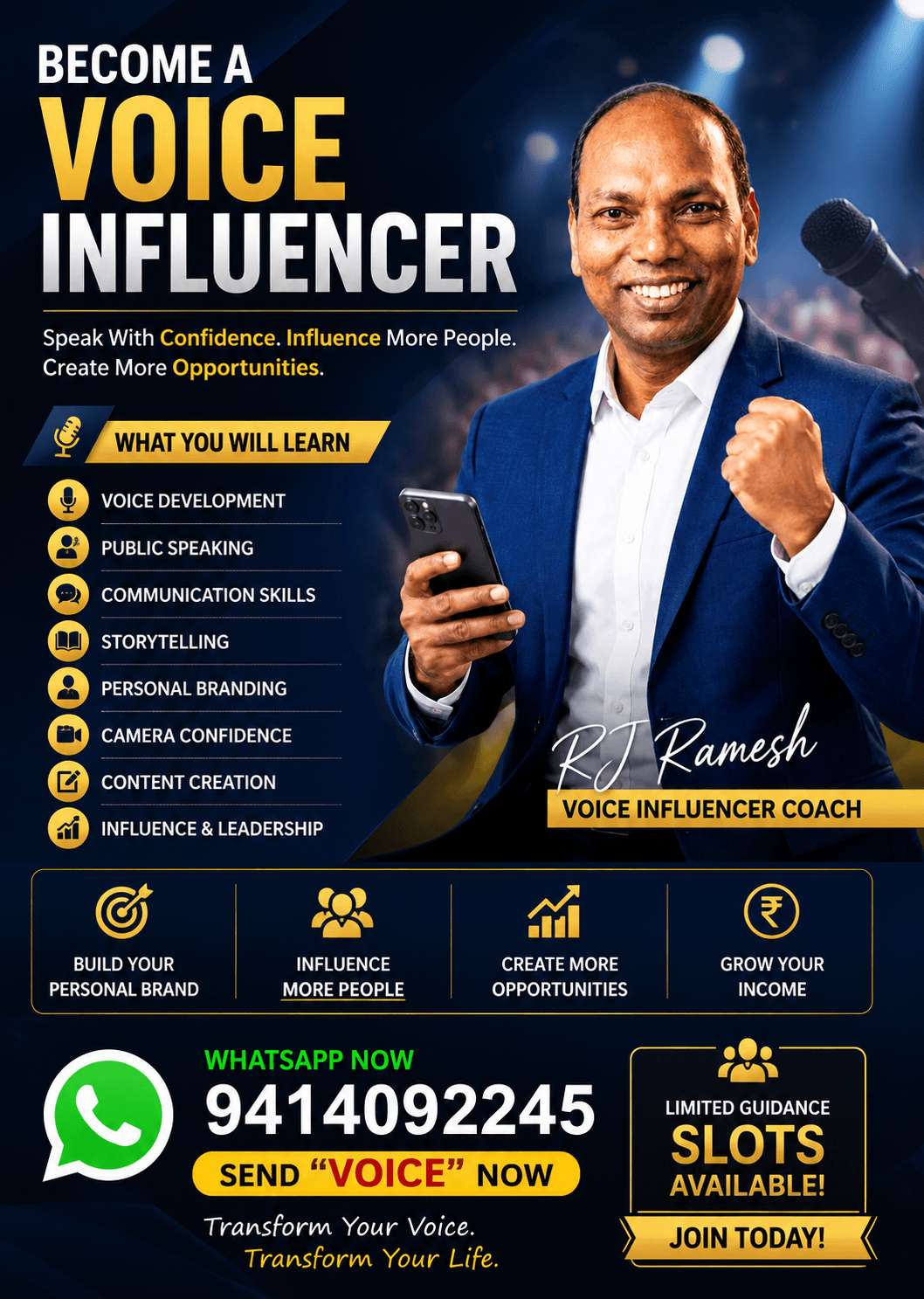
HEY, I’M Ramesh

...I was born in Ambernath the Holy Place of God Shiva. A very Famous Historical Temple Named Shiv Mandir. Many people from outside come and visit every Monday it has huge crowd. Myself with Family also used to go and sit their and experience Peace. It is near Mumbai Dist- Thane. I was very dear n lovely child in my Family because of my smiling face n cheerful nature but some people used to get angry due to My laughing habit.


JOIN MY MAILING LIST
Become A Voice Influencer
Learn how powerful communication and voice coaching can build confidence, influence people, strengthen leadership, and transform your life. Join Rj Ramesh's voice influencer journey.
Why Your Voice Is More Valuable Than Ever. A few decades ago, opportunities to reach large audiences were limited.
People needed access to radio stations, television channels, newspapers, or publishing houses. Today, the internet has changed everything. Anyone with a smartphone

Digital coaching and AI are not opposing forces.
They are complementary forces. AI provides speed.
Humans provide wisdom. AI processes information.
Humans create meaning. AI generates possibilities.
Humans make decisions. The future belongs to individuals who learn how to combine both. Whether you are a coach, speaker, trainer, entrepreneur, educator, or voice influencer, the opportunity has never been greater. Use technology wisely. Continue developing your communication skills.
Build authentic relationships. Share your knowledge generously.
And remember: The most powerful technology in the world is still the human mind guided by purpose. AI can amplify your voice. But only you can provide the message.